Research Program
The FLUX Lab combines mechanistic numerical modeling with advanced computational and observational technologies to solve environmental challenges in both natural and engineered systems. The research program is organized into three interconnected thrusts.
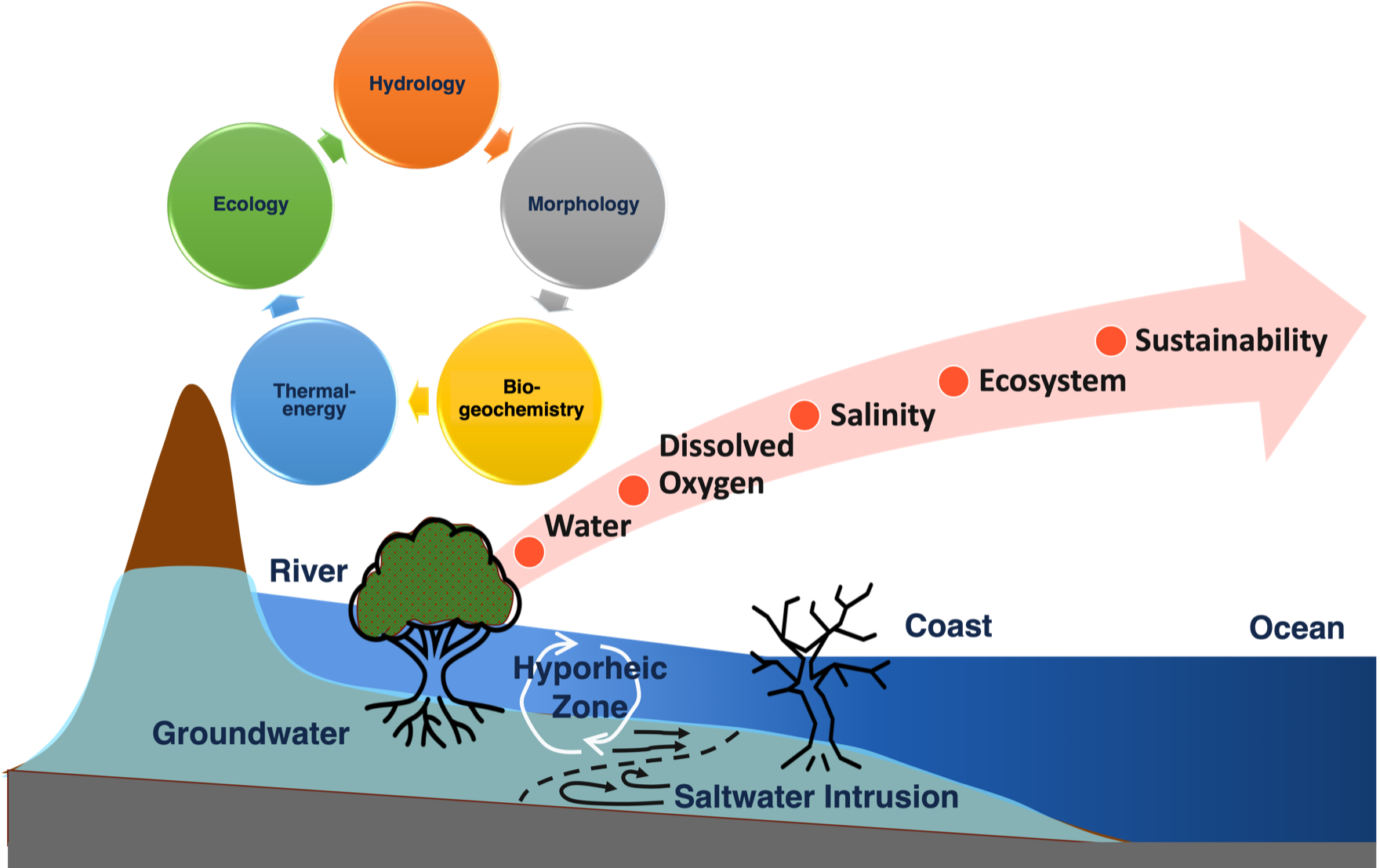
This research integrates critical-zone processes into a coupled hydro-biogeochemical-ecological modeling framework. By synthesizing surface–subsurface flow, sediment morphodynamics, and reactive-transport dynamics, the lab quantifies how natural hazards — such as floods, droughts, and hurricanes — drive ecological responses and long-term ecosystem health.
This research examines how human decision-making — in urban development, land use, and renewable-energy infrastructure — reshapes surface runoff, groundwater recharge, and nutrient cycles, and how those changes feed back to water quality, stormwater management, and the sustainability of coupled human-water systems.
This research characterizes nutrient mass transfer and momentum exchange across the sediment–water interface, with particular attention to the effects of aquatic vegetation, animal activity, and pollutants on bedform evolution and benthic fluxes.
Approach
Process-based CFD, hydrologic, and transport models — from pore- and hyporheic-zone physics to watershed and critical-zone scales.
Remote sensing, GIS, and data-driven / machine-learning approaches to constrain and accelerate large-scale simulations.
Laboratory flume experiments and field measurement to ground models in real systems and close the loop between theory and data.
Foundations
The lab's program builds on a decade of research connecting surface and subsurface waters: large-scale hydrodynamic and water-quality modeling of urban waterways (EFDC); a multi-scale framework for sediment oxygen demand and dissolved-oxygen dynamics coupling hyporheic mass transfer (OpenFOAM) with benthic biogeochemistry (CrunchFlow); development of the MODFLOW 6 groundwater energy transport (GWE) package with the U.S. Geological Survey; and current work on groundwater–surface-water interaction, saltwater intrusion, marsh migration, and wave-driven bedform/solute exchange.